
Compliance
Assurance
Products designed to IEC 60601-1 medical electrical safety and EMC requirements; Portwell's quality management system is certified to ISO 13485:2016 for medical devices.
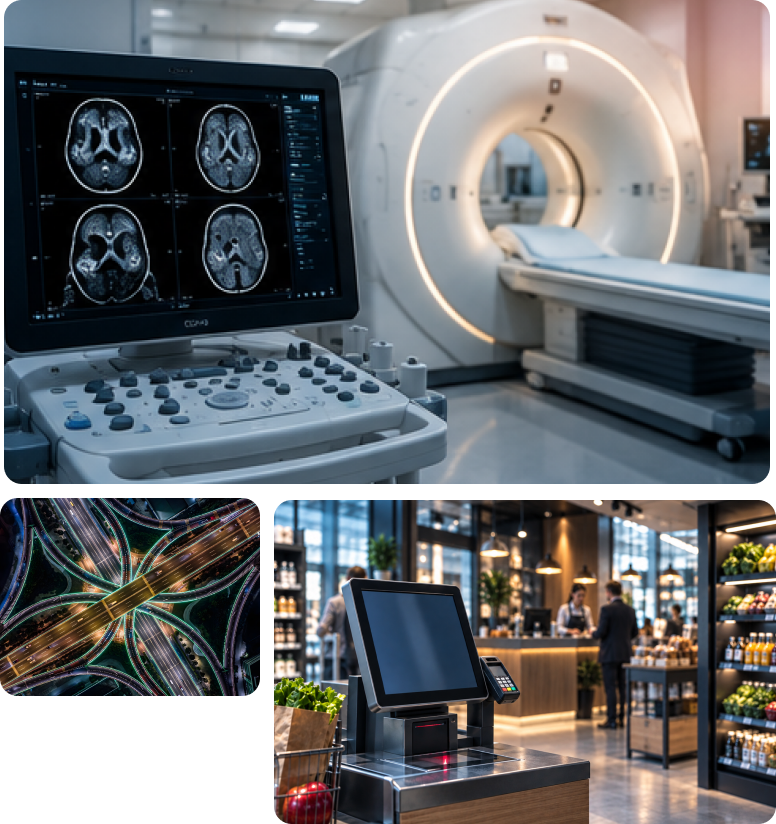
In the fast-evolving medical industry, computing platforms play a critical role. Portwell combines medical-grade design, compliance validation and Edge AI technology to deliver reliable and scalable healthcare computing solutions.
Our portfolio supports medical device OEMs, healthcare equipment manufacturers, system integrators and clinical applications across medical imaging, patient monitoring, surgical imaging, pharmacy automation, point-of-care devices, ultrasound and computer-aided diagnosis.
Leveraging 30+ years of industrial computing expertise, Portwell combines medical-grade design, compliance validation, and Edge AI technology to deliver comprehensive healthcare computing solutions that enable innovation and scalability.
What sets Portwell apart for
healthcare OEMs and engineering teams:
Products designed to IEC 60601-1 medical electrical safety and EMC requirements; Portwell's quality management system is certified to ISO 13485:2016 for medical devices.
EMI, ESD, HALT, vibration, and reliability testing in Portwell's fully equipped labs - compliance de-risked before your certification run.
Design and manufacturing services from concept to volume production, purpose-built for medical OEM/ODM projects.
AI-powered diagnostics and data processing with Edge AI-ready platforms, from GPU-equipped imaging computers to NPU-enabled embedded boards.
Fanless, low-power, low-noise designs engineered for patient-adjacent environments where silence and stability matter.
Medical computing environments demand a combination of safety, stability, compliance and long-term availability. Portwell designs its healthcare computing platforms around these requirements to support reliable operation throughout the medical device lifecycle.
Portwell products comply with medical requirements such as IEC 60601-1, while its quality management system is certified to ISO 13485:2016 for medical devices.
Fanless cooling, anti-vibration construction, dust protection and low power consumption support stable 24/7 operation in healthcare environments.
Isolation designs for LAN, COM, USB and other interfaces help reduce electrical noise, improve signal transmission and provide high-voltage insulation between connected equipment.
Portwell healthcare computing platforms offer up to a 10-year product lifecycle with managed revision control, supporting long-term development and certified medical designs.
Portwell supports medical device manufacturers, healthcare equipment developers and system integrators across a wide range of medical and clinical applications.
Computing platforms for diagnostic imaging, visualization and computer-aided analysis.
Reliable computing for surgical imaging and connected medical systems.
Industrial-grade computing for automated pharmacy and medication management systems.
Compact, reliable computing for medical devices used directly at the point of care.
Computing platforms supporting visualization, image processing and system integration.
High-performance computing for intelligent diagnostic and therapeutic applications.
Reliable interactive computing for connected healthcare and self-service applications.
Portwell offers a broad portfolio of medical-grade computing platforms designed to address different performance, integration and application requirements across healthcare.
Compact, reliable computing platforms for medical equipment, point-of-care applications and clinical environments.
Integrated medical computing solutions combining display and computing capabilities for healthcare applications.
Medical-grade displays designed for high-quality visualization in clinical and diagnostic environments.
Medical-grade networking solutions supporting reliable connectivity and integration in healthcare environments.
High-performance computing platforms for medical imaging, visualization and AI-intensive workloads.
Medical OEM/ODM projects demand more than catalog hardware. They require a supplier whose processes, quality systems and engineering capabilities support the complete product lifecycle. Portwell's DMS includes:
Custom carrier boards, isolated I/O designs and enclosures for medical equipment integration.
Support for IEC 60601-1 and IEC 60601-1-2, with in-house EMI, ESD, HALT and reliability testing.
BIOS and firmware customization, OS image pre-loading and cybersecurity hardening.
Locked BOMs, revision control and up to 10-year supply continuity.
Pilot-to-volume manufacturing with full traceability under an ISO 13485:2016 certified quality management system.
Reliable medical computing for connected patient monitoring applications.
Reliable medical computing for connected patient monitoring applications.
Reliable medical computing for connected patient monitoring applications.
Technical insights into embedded computing, Edge AI and next-generation platforms.
view whitepapersPractical solutions and implementation examples for your application.
view technical guidesIEC 60601-1 is the international standard for the basic safety and essential performance of medical electrical equipment. It covers electrical safety, protection against mechanical hazards, leakage currents and the isolation between a device and the patient. A computer built into a medical device becomes part of that device, so the complete system has to be assessed against the standard. Starting from a platform that was designed to these requirements – with the matching isolation, power supply and documentation – removes a large part of the certification effort. IEC 60601-1-2 adds the electromagnetic compatibility requirements for the same equipment.
ISO 13485 is the quality management standard for medical device manufacturers and their suppliers. It governs how a product is designed, documented, built and changed, including traceability, change control and corrective actions. For a computing platform this is what makes a device auditable: you can show where each part came from, which revision was built when, and how a change was validated. A supplier without that system forces you to compensate with your own incoming inspection and documentation. Portwell’s quality management system is certified to ISO 13485:2016 for medical devices.
Both are built for continuous operation and long availability. A medical computer adds the requirements that come from working next to a patient: isolated interfaces and power supplies, leakage currents within the limits of IEC 60601-1, electromagnetic behaviour that does not disturb other equipment, and housings that can be cleaned. Fanless, low-noise designs are the rule rather than the exception. The documentation differs as well – a medical platform comes with the test reports and declarations needed for the device certification.
The most common use is image analysis: supporting clinicians in detecting and measuring findings, reconstructing and enhancing scans, and pre-sorting studies. Beyond imaging, AI is used for patient monitoring, where it recognises patterns in vital signs earlier than a threshold alarm would, for computer-aided diagnosis, for workflow and resource planning, and in intelligent medical devices such as surgical and ultrasound systems. What these have in common is that the processing happens close to the device – because of latency, data protection and the need to work without a reliable network connection. That is what Edge AI platforms are for.
Imaging workloads are dominated by GPU performance, memory bandwidth and I/O: reconstruction, visualization and AI inference all run on the graphics processor. A platform for imaging therefore needs a discrete GPU or an AI accelerator, enough PCIe lanes for frame grabbers and storage, and a thermal design that can sustain that load continuously and quietly. On the medical side the usual requirements apply – isolated interfaces, IEC 60601-1 compliance and a long product lifecycle. Portwell covers this with its medical GPU systems and medical box PCs.
Portwell healthcare computing platforms offer up to a ten-year product lifecycle with managed revision control. Component changes are tracked and communicated rather than made silently, so a certified design stays valid and a requalification is only needed when something genuinely changes. For projects with their own supply requirements, locked bills of material and extended supply agreements are part of the Design & Manufacturing Services.
Yes – that is what the Design & Manufacturing Services are for. They range from a changed I/O set, custom carrier boards and isolated interfaces to a custom enclosure, BIOS and firmware customization, pre-loaded OS images and private labelling. Compliance support covers IEC 60601-1 and IEC 60601-1-2 with in-house EMI, ESD, HALT and reliability testing, and manufacturing runs from pilot to volume under an ISO 13485:2016 certified quality management system.
Talk to our team about your application, compliance requirements, computing performance and lifecycle expectations.